
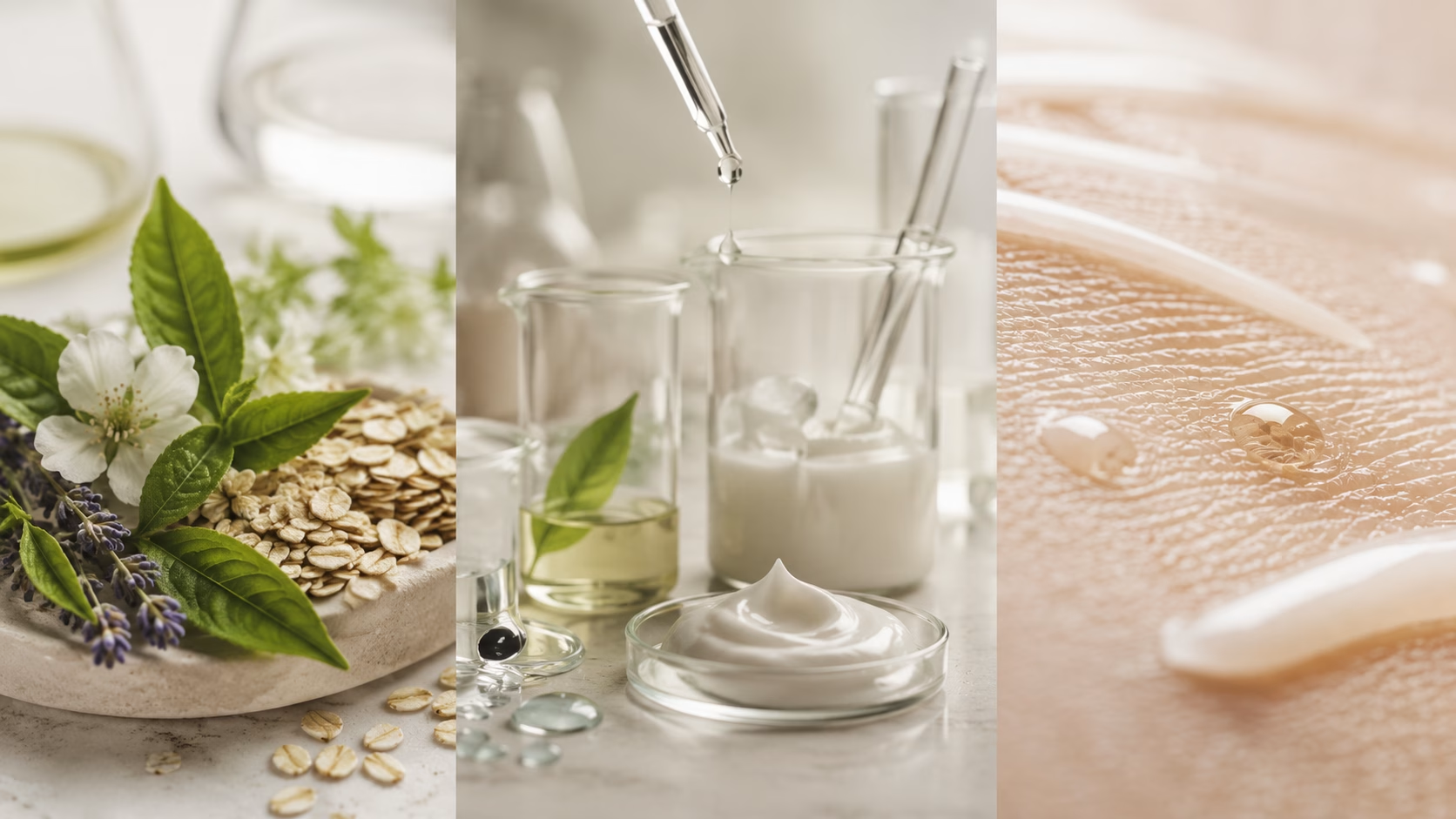
Natural skincare can be biologically meaningful, but origin is not enough. It becomes credible when the ingredient is defined, stable, well formulated and compatible with the skin.
Table of Contents
Natural skincare attracts people for a reason. A plant extract, an oat compound, a tea polyphenol or an aromatic resin can feel closer to living chemistry than a label full of unfamiliar chemical names. That instinct is not foolish. Plants contain real molecules, and some of those molecules can matter on skin.
That part is worth taking seriously.
The mistake is treating origin as proof. Natural chemistry does not become skincare science just because it came from a plant. The skin does not receive a philosophy of purity. It receives exposure: molecules or mixtures at a certain concentration, in a certain vehicle, with a certain stability profile, for a certain contact time, on a barrier that may be calm, dry, reactive, acne-prone, over-exfoliated or inflamed.
Natural is not automatically better. It is also not just marketing. It becomes a serious starting point when the chemistry is real and the formula makes it readable.
That is where natural skincare becomes interesting in a scientific sense. Not when it sounds pure. Not when a label says botanical. It becomes credible when the ingredient is specific enough, stable enough, formulated well enough, tolerated well enough and supported closely enough to carry the claim being made.
The useful question is not whether natural is better than synthetic. That debate is too crude for real skin biology. The better question is simpler and more demanding: what does the skin actually receive?
The three tests of natural skincare science
A natural skincare claim becomes easier to judge when it passes through three questions:
- Is the ingredient defined enough to evaluate?
- Is it formulated to remain biologically relevant?
- Does it fit the skin context and the claim?
Those questions do not make natural ingredients less interesting. They make them legible. They let a botanical story become a biological exposure.
The useful question is not just where an ingredient came from
Origin can matter. It can shape the compounds present in an extract, the impurities that come with it, the way it is processed, the sustainability of sourcing and the likelihood of certain allergens or fragrance molecules. A botanical extract is not the same thing as a purified molecule, and a whole plant name is not the same thing as a standardized ingredient.
But origin is context, not evidence.
A natural label does not tell you the dose. It does not tell you whether the active fraction is standardized. It does not tell you whether a compound survives light, air, water, pH shifts or months of storage. It does not tell you whether the ingredient is in a rinse-off cleanser or a leave-on cream. It does not tell you whether the product was tested for the benefit being claimed.
This is why the natural-versus-synthetic debate usually misses the point. A natural ingredient can be well defined, elegant and useful. A natural ingredient can also be vague, unstable, irritating or present at a decorative level. A non-botanical ingredient can be poorly tolerated, but it can also be purified, stable and controlled. The category is not the biology.
The skin receives a formula, not a story.
The outer layer of skin is not a passive sheet. The stratum corneum is a structured barrier built from corneocytes, extracellular lipid domains and water-binding components, while the broader skin surface also interacts with enzymes, microbes and immune-relevant signals. It helps control water loss, limits many exposures and changes how topical ingredients behave (Elias, 2005; Proksch et al., 2008).
A formula changes that exposure. Vehicle, pH, oils, emulsifiers, solvents, surfactants, water content, particle size, packaging and contact time can all influence whether an ingredient stays on the surface, partitions into barrier lipids, degrades before it acts, irritates or remains too dilute to matter (Lane, 2013; Benson et al., 2019).
So the biological path is not plant to benefit. It is closer to this:
Origin -> ingredient identity -> active fraction -> formula stability -> vehicle and contact time -> barrier context -> evidence-matched claim.
That path is less romantic than the label. It is also what lets the natural story become scientifically useful.
Test 1: Is the ingredient defined enough to evaluate?
The first test is definition. A plant name may sound specific, but scientifically it can be almost empty. Which part of the plant? Which extraction method? Which solvent? Which marker compounds? Which concentration? Which batch controls?
A plant name is not always an active ingredient
This matters because botanical materials vary. A root extract, seed oil, leaf extract and fermented derivative may all carry the same plant identity in marketing language while exposing the skin to very different chemistry. Even within the same botanical category, harvest conditions, extraction, processing, oxidation and storage can change the final material.
Standardization does not make a natural ingredient less natural. It makes the claim more readable. A defined extract, active fraction or functional material can be compared with evidence. A vague botanical blend mostly asks the reader to trust the mood of the label.
Positive example: what colloidal oatmeal gets right
Colloidal oatmeal is a useful positive example because its credibility does not come from the idea that oats sound gentle. It comes from a defined topical role. In skincare, colloidal oatmeal is used as a finely milled oat material with relevance to barrier comfort, moisturization and irritation-related endpoints. Its components, including starches, beta-glucans, lipids and avenanthramides, provide a plausible basis for soothing and barrier-supportive effects. Human and product-level evidence supports modest claims around dryness, itch or irritation-related comfort and tolerability (Kurtz & Wallo, 2007; Criquet et al., 2012; Reynertson et al., 2015).
That does not prove that natural ingredients are better. It shows something more precise, and more useful: a natural-derived ingredient can be credible when the material is defined, the function is clear and the claim stays close to the evidence.
Test 2: Is it formulated to remain biologically relevant?
The second test is formulation. A natural compound can be chemically interesting and still fail as a skincare claim if the formula does not protect it, deliver it or keep it relevant long enough to matter.
Stability is part of the biology
Ingredient lists are static. Skin exposure is not. Compounds can oxidize, degrade, bind to other components, separate from a formula or lose activity during storage and use. Packaging, light, air exposure, water content, pH and vehicle can all change what reaches the skin.
That means formulation is not cosmetic decoration. It is the translator between natural chemistry and skin exposure. A fragile antioxidant in a poorly protected formula may look impressive on a label while delivering little active exposure. A modest ingredient in a stable, well-designed vehicle may be more biologically legible than a dramatic botanical story with no delivery logic.
Green tea and EGCG make formulation visible
Green tea polyphenols, especially EGCG, make the point clearly. The biology is serious enough to take seriously: green tea catechins have antioxidant and anti-inflammatory plausibility, and controlled human skin research has examined photoprotection-related endpoints (Elmets et al., 2001; Katiyar, 2011). But EGCG is also chemically demanding. Its stability can be affected by pH, temperature, concentration, oxygen, formulation environment and interactions with other cosmetic ingredients, which is why a label that says green tea extract is not enough by itself (Frasheri et al., 2020).
The lesson is not that green tea skincare works or does not work as a category. The lesson is sharper: a natural antioxidant story only becomes scientifically useful when identity, stability, concentration, vehicle, packaging and endpoint are defined.
Test 3: Does it fit the skin context and the claim?
The third test is fit. The same ingredient can be reasonable in one product and noisy in another. Skin context changes the meaning of exposure.
The same formula does not meet every barrier the same way
Dry, reactive, eczema-prone, rosacea-prone, acne-prone or recently over-exfoliated skin can have different tolerance thresholds. A formula that feels elegant on intact skin may sting on compromised skin. A fragrance-rich leave-on product creates a different exposure than a rinse-off cleanser. A soothing claim may be reasonable for one endpoint and overextended for another.
This is where natural skincare needs precision, not cynicism. Gentle is not a property of origin alone. It is a property of the finished exposure on a particular barrier context. Product type, concentration, contact time, irritancy, allergen profile and repeated use all matter.
Essential oils show why exposure context matters
Essential oils and fragrance-rich natural materials are useful examples not because they are inherently bad, but because they show how exposure chemistry can change the answer. Fragrance terpenes such as limonene and linalool can oxidize, and their oxidation products, including hydroperoxides, are clinically relevant contact allergens in susceptible or repeatedly exposed users (Karlberg et al., 1992; Bråred Christensson et al., 2016; Deza et al., 2017; de Groot & Schmidt, 2016).
That is not an argument against every fragrant or essential-oil-containing product. It is an argument for asking better questions: Is it leave-on or rinse-off? How concentrated is the fragrance load? Has the material oxidized? How is it packaged and stored? Is the user already sensitized or barrier-reactive?
Natural risk, when it exists, is not a moral failure of plants. It is chemistry meeting skin context.
What kind of claim can the evidence actually support?
Once the ingredient is defined, formulated and placed in a skin context, the final question is evidence. Not all skincare claims ask the same thing from the science.
Comfort, hydration and irritation are not the same claim as regeneration
A claim about dryness comfort is not the same as a claim about collagen rebuilding. A claim about reduced irritation-related discomfort is not the same as a claim about microbiome repair. Antioxidant activity in a cell model is not the same as visible skin improvement in a finished product.
A simple evidence ladder helps:
- Weakest support: general origin language, such as botanical, natural or clean.
- Better support: defined ingredient identity and plausible mechanism.
- Stronger support: ingredient data in a relevant topical context.
- Most useful support: finished-product human evidence that matches the dose, vehicle, duration, population and endpoint.
That ladder matters because many claims sound scientific while stopping too early. Contains green tea is not the same as stable EGCG delivery. Contains botanical oils is not the same as barrier benefit. Clinically tested is not automatically the same as clinically meaningful. The design, comparator, endpoint, duration and finished formula still matter.
Ingredient plausibility is not finished-product proof
Mechanistic evidence is valuable. It explains why an ingredient deserves attention. But it does not automatically prove that a finished product changes skin in a meaningful way. A compound can look promising in a dish, behave differently in a formula and become irrelevant on real skin if it is unstable, underdosed, poorly delivered or mismatched to the claim.
This is why the three examples belong together. Colloidal oatmeal shows what a modest, defined and evidence-readable natural role can look like. Green tea / EGCG shows that biological interest needs formulation support. Essential oils and oxidized fragrance compounds show that natural chemistry can change under real exposure conditions.
What the three examples teach
Colloidal oatmeal teaches that natural can be credible when the function is clear and the endpoint is modest.
Green tea / EGCG teaches that a natural compound can be biologically interesting and still formulation-dependent.
Essential oils and oxidized fragrance compounds teach that exposure context, oxidation and barrier state matter more than whether an ingredient sounds familiar.
Together, they turn natural skincare science from a label into a standard.
The better standard: from natural label to biological credibility
Natural skincare is not nonsense. It is also not proof. It becomes science when the ingredient can be evaluated as a real topical exposure.
That means the strongest natural skincare claims usually have a few things in common. The ingredient is defined. The active fraction or functional material is clear enough to discuss. The formula protects or delivers it in a sensible way. The product fits the skin context. The evidence supports the specific claim being made.
A practical filter for natural skincare claims
Before trusting a natural skincare claim, ask:
- What is the actual ingredient or extract, not just the plant name?
- Is the active fraction standardized or otherwise defined?
- Could the ingredient degrade, oxidize or become unstable in the formula?
- Does the vehicle fit the intended function?
- Is the product leave-on or rinse-off, mild or fragrance-heavy, simple or biologically noisy?
- Does the evidence support this exact kind of claim, or only a weaker mechanism?
Those questions are not anti-natural. They are pro-clarity. They protect the part of natural skincare that deserves to be taken seriously from the vague claims that borrow credibility from nature without doing the scientific work.
The future will make this even more important. Some ingredients will come from plants. Some will be nature-derived. Some will come from fermentation or biotechnology while remaining chemically similar to compounds found in nature. The old categories will keep blurring. The standard should not blur with them.
Natural is the beginning of the question, not the answer. Biological credibility begins when the formula makes the ingredient specific, stable, tolerable and evidence-readable enough for the skin claim it is asked to carry. That kind of question sits at the center of Ingredient Science.
Frequently Asked Questions
Is natural skincare better for your skin?
Not by origin alone. Natural ingredients can be biologically useful, but the formula still has to define the ingredient, keep it stable, fit the skin barrier and support the claim with relevant evidence.
What makes a natural skincare ingredient biologically credible?
A natural ingredient becomes more credible when its identity, active fraction, stability, vehicle, contact time, skin-barrier fit and evidence are clear enough to evaluate.
Why does formulation matter for natural skincare?
Formulation determines what the skin actually receives. Vehicle, pH, water content, packaging, concentration and contact time can change whether a natural compound remains stable, reaches the right exposure context and supports the claim being made.
Is green tea extract in skincare always effective?
No. Green tea polyphenols such as EGCG are biologically interesting, but a product label does not prove active catechins are stable, present at a meaningful concentration or tested for the claim being made.
Are essential oils bad for skin?
Not inherently. Essential oils and fragrance-rich natural materials are better understood through exposure context: oxidation, concentration, leave-on versus rinse-off use, repeated exposure and the person’s barrier or sensitization history.
References
Benson, H. A. E., Grice, J. E., Mohammed, Y., Namjoshi, S., & Roberts, M. S. (2019). Topical and transdermal drug delivery: From simple potions to smart technologies. Current Drug Delivery, 16(5), 444-460. https://doi.org/10.2174/1567201816666190201143457
Bråred Christensson, J., Karlberg, A. T., Andersen, K. E., Bruze, M., Johansen, J. D., Garcia-Bravo, B., Giménez-Arnau, A., Goh, C. L., Nixon, R., & White, I. R. (2016). Oxidized limonene and oxidized linalool: Concomitant contact allergy to common fragrance terpenes. Contact Dermatitis, 74(5), 273-280. https://doi.org/10.1111/cod.12545
Criquet, M., Roure, R., Dayan, L., Nollent, V., & Bertin, C. (2012). Safety and efficacy of personal care products containing colloidal oatmeal. Clinical, Cosmetic and Investigational Dermatology, 5, 183-193. https://doi.org/10.2147/CCID.S31375
de Groot, A. C., & Schmidt, E. (2016). Essential oils, Part IV: Contact allergy. Dermatitis, 27(4), 170-175. https://doi.org/10.1097/DER.0000000000000197
Deza, G., García-Bravo, B., Silvestre, J. F., Pastor-Nieto, M. A., González-Pérez, R., Heras-Mendaza, F., Mercader-García, P., Fernández-Redondo, V., Niklasson, B., & Giménez-Arnau, A. M. (2017). Contact sensitization to limonene and linalool hydroperoxides in Spain: A GEIDAC prospective study. Contact Dermatitis, 76(2), 74-80. https://doi.org/10.1111/cod.12714
Elias, P. M. (2005). Stratum corneum defensive functions: An integrated view. Journal of Investigative Dermatology, 125(2), 183-200. https://doi.org/10.1111/j.0022-202X.2005.23668.x
Elmets, C. A., Singh, D., Tubesing, K., Matsui, M., Katiyar, S., & Mukhtar, H. (2001). Cutaneous photoprotection from ultraviolet injury by green tea polyphenols. Journal of the American Academy of Dermatology, 44(3), 425-432. https://doi.org/10.1067/mjd.2001.112919
Frasheri, L., Schielein, M. C., Tizek, L., Mikschl, P., Biedermann, T., & Zink, A. (2020). Great green tea ingredient? A narrative literature review on epigallocatechin gallate and its biophysical properties for topical use in dermatology. Phytotherapy Research, 34(9), 2170-2179. https://doi.org/10.1002/ptr.6670
Karlberg, A. T., Magnusson, K., & Nilsson, U. (1992). Air oxidation of d-limonene creates potent allergens. Contact Dermatitis, 26(5), 332-340. https://doi.org/10.1111/j.1600-0536.1992.tb00129.x
Katiyar, S. K. (2011). Green tea prevents non-melanoma skin cancer by enhancing DNA repair. Archives of Biochemistry and Biophysics, 508(2), 152-158. https://doi.org/10.1016/j.abb.2010.10.018
Kurtz, E. S., & Wallo, W. (2007). Colloidal oatmeal: History, chemistry and clinical properties. Journal of Drugs in Dermatology, 6(2), 167-170.
Lane, M. E. (2013). Skin penetration enhancers. International Journal of Pharmaceutics, 447(1-2), 12-21. https://doi.org/10.1016/j.ijpharm.2013.02.040
Proksch, E., Brandner, J. M., & Jensen, J. M. (2008). The skin: An indispensable barrier. Experimental Dermatology, 17(12), 1063-1072. https://doi.org/10.1111/j.1600-0625.2008.00786.x
Reynertson, K. A., Garay, M., Nebus, J., Chon, S., Kaur, S., Mahmood, K., Kizoulis, M., & Southall, M. D. (2015). Anti-inflammatory activities of colloidal oatmeal (Avena sativa) contribute to the effectiveness of oats in treatment of itch associated with dry, irritated skin. Journal of Drugs in Dermatology, 14(1), 43-48.